Building on a standard 50x100 foot plot (approx. 15.24x30.48 meters) in Uganda requires a strategic balance between spatial design and strict physical planning guidelines. By implementing vertical design layouts, calculating exact setback widths, and conducting geotechnical assessments, developers can achieve high room yields while ensuring regulatory approval.
The standard 50x100 foot parcel - measuring approximately 15.24x30.48 meters and yielding a gross area of 464.5 square meters (0.115 acres) - remains the standard unit of land transaction and structural development in urban Uganda, from Kira and Nansana down to Mukono and Entebbe. Maximizing the yield of this spatial envelope while remaining fully compliant with municipal physical planning standards requires an optimal balance of spatial planning, structural design, and geotechnical engineering.
Spatial Yield and Layout Configurations
When evaluating a 50x100 foot plot, developers must choose between maximizing raw room count under low-income tenancy models or optimizing spatial layout for premium multi-family rental blocks or single-family bungalows.
- Affordable High-Density Housing: For affordable housing models targeting high-density tenancy, a single-story U-shaped or L-shaped courtyard layout can accommodate up to 10 to 12 standard single rooms, with each room measuring 10x12 feet (3.05x3.66 meters). This design directs door openings inward toward a communal central courtyard, leaving a narrow buildable strip at the margins. It requires careful positioning of a shared sanitation block and septic system at the rear of the plot to prevent soil saturation near the main structures.
- Premium Multi-Family Rentals: To attract professional, high-income tenants, developers should construct vertical double-room or single-bedroom units. A two-story block (ground plus one floor) can accommodate 4 to 6 self-contained units (each comprising a living area, kitchenette, shower room, and bedroom). This multi-floor design preserves up to 40% of the ground footprint for vehicular parking and green areas.
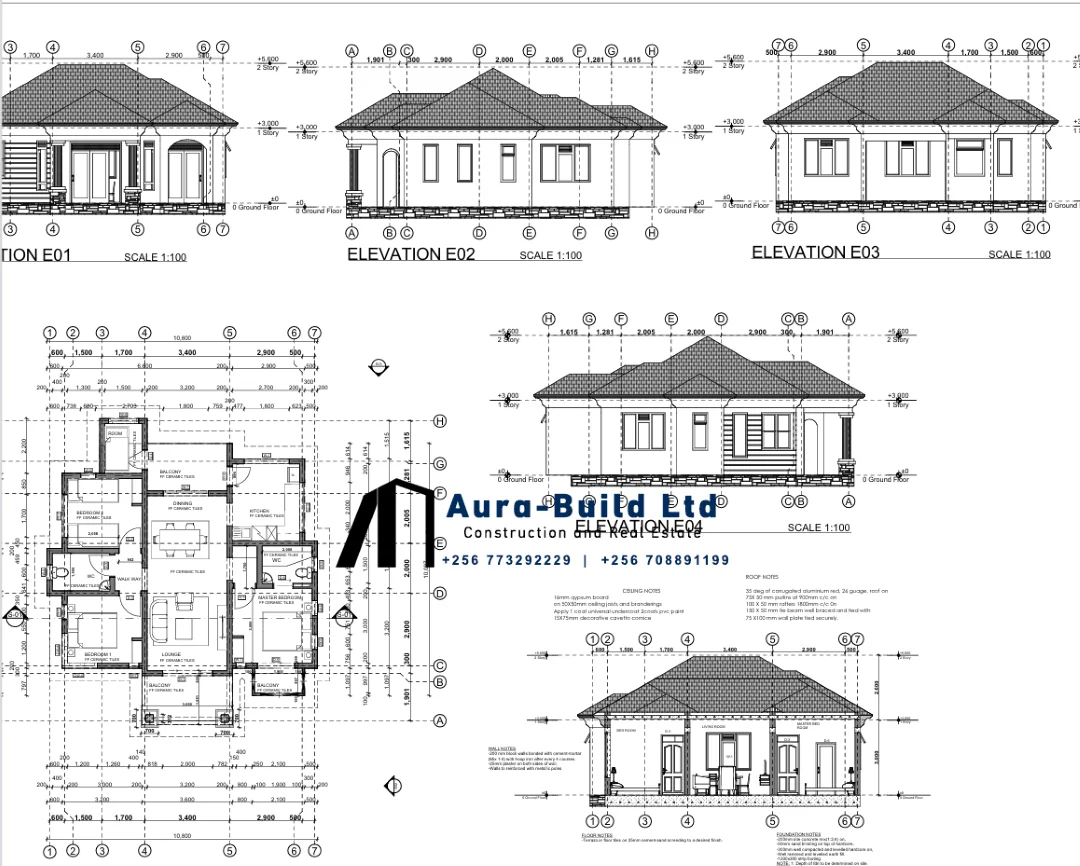
- Owner-Occupier Bungalows: For single-family residential developments, a single-family bungalow typically occupies a footprint of 120 to 150 square meters, leaving ample space for a domestic helper's quarter, gatehouse, and a driveway.
- Mixed-Use Developments: These layouts utilize the street-facing boundary for retail shops on the ground level, while shielding private residential quarters on the upper floor or rear portion of the property.
Support Infrastructure and Municipal Setbacks
The Physical Planning Act of 2010 mandates strict setbacks that restrict the buildable footprint on a 50x100 foot plot. For residential developments, the standard setbacks are:
- Front Setback: Minimum 4.5 meters from the road reserve edge.
- Side Setbacks: Minimum 1.5 meters on both left and right boundaries.
- Rear Setback: Minimum 3.0 meters from the back boundary.
Subtracting these setbacks reduces the maximum buildable footprint width to 12.24 meters and the length to 22.98 meters, yielding a net buildable ground footprint of approximately 281 square meters.
Infrastructure elements within this setback zone must be carefully designed:
- Septic System Planning: A multi-unit development requires an underground, double-chamber concrete septic tank. For 15 to 20 active daily users, the tank must have a minimum volume of 7.7 cubic meters, with standard dimensions of 1.8 meters in width x 2.4 meters in length x 1.8 meters in liquid depth. The primary chamber must comprise two-thirds of the total volume to facilitate optimal anaerobic digestion before the effluent drains into an adjacent sand-lined soak pit.
- Parking Layouts: Standard parking bays require 2.5x5.0 meters of clear space per vehicle. A 50x100 foot plot optimized with side setbacks can fit up to 3 vehicles parallel to the front boundary or along a side access driveway.
- Drainage Gradients: Stormwater drainage channels must maintain a minimum gradient of 1:100 (1%) to prevent pooling, redirecting surface runoff toward municipal stormwater networks.
Geotechnical Considerations in Expansive and Swampy Soils
Low-lying areas in the Kampala Metropolitan Area, including portions of Kira, Lubigi, Nansana, and Munyonyo, feature high water tables and weak, expansive alluvial or organic clay soils. In these zones, traditional shallow strip foundations are highly susceptible to differential settlement, which can lead to structural wall cracks and structural failure.
Before foundation design begins, developers should conduct a geotechnical soil investigation. For low-rise residential structures in swampy areas, standard Dynamic Cone Penetrometer (DCP) or Dynamic Light Penetrometer (DPL) tests are combined with manual trial pits to map the depth of the load-bearing laterite layer.
For typical small-scale residential plots, a basic geotechnical investigation - including mobilization, 2 to 3 DCP test points, trial pits, laboratory soil classification, and a professional interpretive report - costs between 1,500,000 UGX and 3,500,000 UGX. For multi-story commercial projects or complex ground profiles, deep rotary drilling (up to 20 meters or deep into the rock head), Standard Penetration Testing (SPT), water table monitoring, and advanced laboratory testing (triaxial shear strength and oedometer consolidation tests) can cost between 15,000,000 UGX and 90,000,000 UGX, depending on the depth and quantity of boreholes.
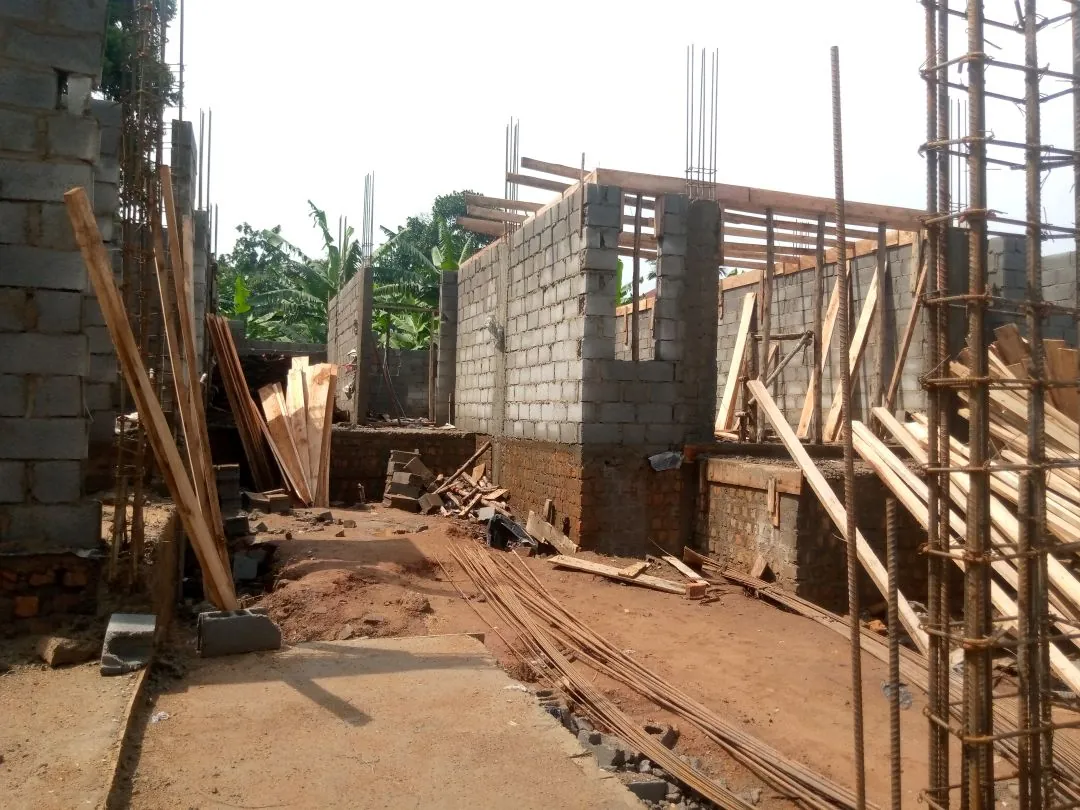
If the soil bearing capacity is less than 100 kN/m2 in swampy regions, structural engineers must replace standard strip foundations with a reinforced concrete raft foundation or concrete ground-improvement piles. This ensures that structural loads are distributed evenly across the footprint or transferred down to stable rock or stiff laterite layers.
Standard Development Cost Ranges (Uganda 2026)
The table below outlines typical budget ranges for standard developments on a 50x100 foot plot in the central region of Uganda (Kampala/Wakiso):
| Configuration | Substructure Design | Shell Cost (UGX) | Finished Cost (UGX) | Key Components |
|---|---|---|---|---|
| Single-Story Bungalow (3 Beds, 120 m2) | Reinforced wide strip foundation, solid clay brick masonry. | 40,000,000 to 65,000,000 | 95,000,000 to 140,000,000 | Timber trusses, concrete floor slab, plastering, tiling. |
| Double-Story Rental Block (6 Units, 240 m2 total) | Reinforced concrete column-and-beam frame, pad footings. | 110,000,000 to 160,000,000 | 240,000,000 to 350,000,000 | Suspended solid reinforced slab, hollow block masonry, premium plumbing. |
| Commercial Retail Block (Single-Story, 150 m2 total) | Heavily reinforced strip foundation, concrete column structure. | 55,000,000 to 80,000,000 | 115,000,000 to 170,000,000 | Open floor plan, large glazed window frames, steel rolling shutters. |
Professional Roles and Integration
Executing a project on a 50x100 foot plot requires the coordination of three primary professionals to protect the developer's legal and physical interests:
- Land Surveyor: Verifies land title boundaries, performs cadastral boundary opening, and installs concrete markers (pips). This prevents encroachment onto neighboring plots or public road reserves, avoiding costly legal disputes or demolition orders.
- Architect: Translates the client's spatial requirements into functional, code-compliant designs while managing setback limits and submitting plans for physical planning approval.
- Structural Engineer: Evaluates soil conditions and calculates the load-bearing requirements for concrete footings, columns, beams, and slabs. This prevents structural failures and ensures the building can safely support its design loads.
Aura Build Ltd Tip: Build with Experts
Custom Structural Engineering: Custom plans match the local soil profile on site, preventing foundation failure.
Zoning Compliance: Designs are made from the outset to comply with specific municipal setback rules.
Independent QS Billing: Ensures cost control via a priced Bill of Quantities.
Common Mistakes on 50x100 Plots
Many developers in Uganda face challenges due to common pitfalls: extending walls into setbacks, hiring unregistered draftsmen, or neglecting soil testing. Unregistered individuals are not bound by professional liabilities, and their plans often lack the engineering details required to secure municipal permits or ensure long-term structural safety.
When to Call an Engineer
If you are planning to build a multi-story block or if your plot is in a low-lying, damp area, contact a registered structural engineer before committing funds. To consult on your structural planning or schedule a soil investigation, contact the engineering team at Aura Build Ltd.