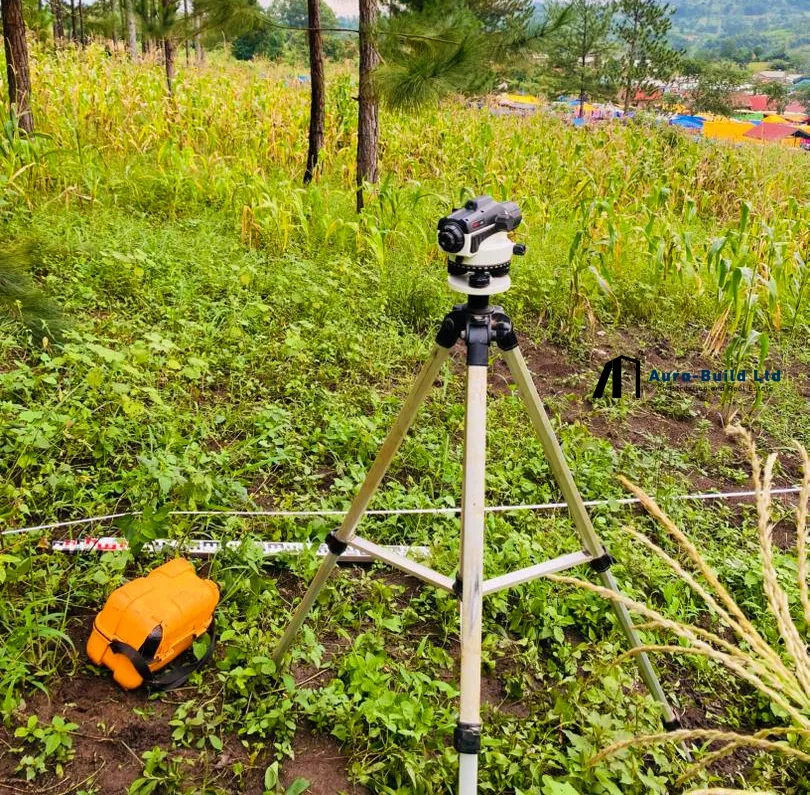
Accurate Land Surveying for Boundary Legalities, Topography, and Site Setting Out
Every successful construction project starts with a precise understanding of the land. For property investors and developers in Uganda, accurate land surveying establishes legal boundaries, maps the physical terrain, and ensures that the building is positioned exactly where it is designed to be.
Land surveying is the precise measurement and mapping of a property's boundaries, dimensions, and elevation changes. It provides the mathematical coordinates and physical data required to legally define a plot and accurately position a building, roads, and drainage systems upon it.
Why It Matters & When It Is Needed
Surveying is the foundational step that informs all subsequent design and engineering work. It establishes legal boundaries to prevent costly encroachment disputes, provides topographic levels essential for drainage and foundation planning, and delivers the spatial coordinates necessary for architects to adapt their designs to the specific site.
Surveying is the very first technical step required upon acquiring land, before any architectural design, site clearing, or construction activities commence.
Typical Outputs
Boundary opening reports
Topographic survey maps (contours and levels)
Digital CAD survey files for the design team
Setting-out coordinate schedules
Established site benchmarks
Title verification documentation
What It Typically Involves
Deed plan and title verification at the land registry
Mobilization of total stations and RTK GPS equipment to the site
Boundary beacon confirmation or reinstatement
Topographic mapping of contours, existing structures, and utilities
Data processing and drafting of survey maps
Setting out of building gridlines prior to excavation
Where It Fits In The Project Journey
Land Surveying Architectural Design Geotechnical Structural Design BOQ Construction
Ready to Take the Next Step?
Clarify the right sequence for your project by discussing your land surveying requirements.